
By AMANDA MINCKLER and KATE SMITH
Creighton Digital Storytellers
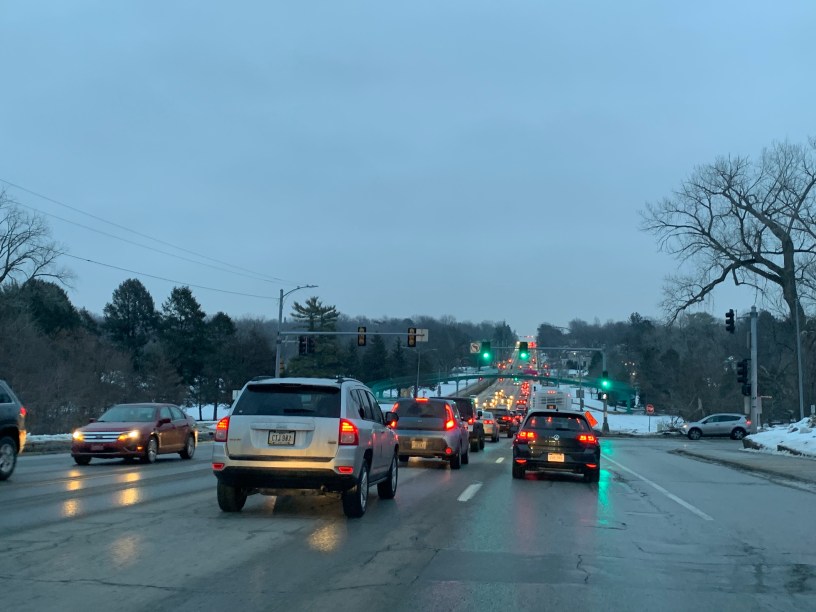
Kurt Irlbeck, director of operations at Mutual of Omaha, leaves his house in Northwest Omaha at 6:30 a.m. for his commute to the 33rd Street office. The route he takes from State Street to Highway 75, along with leaving so early in the morning, is the perfect formula for avoiding traffic and reducing stop time during his commute.
“If I leave at my normal times and take my normal route, it’s very tolerable. If I don’t, not so much,” Irlbeck said.
Irlbeck said his employees that have the flexibility to work from home choose to do so because of traffic. On bad weather days, he said it is common for 75% of his staff to work from home.
“Reliable weather is definitely a factor, along with distance,” Irlbeck said. “I’m in a professional setting, and biking in nicer clothes isn’t ideal. Like many people in Omaha, I actually like driving my own car into work.”
Commuters in Omaha overwhelmingly drive to work individually. Approximately 81.5% of commuters drove to work alone in 2017, according to the US Census Bureau, compared with only 2.71% of commuters walking to work, 1.4% taking public transit and 0.25% riding their bicycles.
Official bike lanes in Omaha are limited to the downtown area and are sparsely located, according to a map available from the Metropolitan Area Planning Agency.
Brian Boerner, vice president of business development at Sandhills Energy, rides his bike to work daily during warm Nebraska months. Boerner said he rides his bicycle to reduce the environmental impact of his commute and get exercise.
“I think we need more bike lanes, not more things like scooters or trollies,” Boerner said. “Create the infrastructure for people to bike, and their habits will change.”
During the winter months, or for longer trips, Boerner uses public transit. He limits his car use to grocery trips and long drives.
“[The bus system] is better than people think but does leave a lot to be desired,” Boerner said. “The bus schedule isn’t very timely, and although there is a GPS tracker on each bus and they have a web application to see where they are on the route, it works only some of the time.”
A 2017 City revenue report said Omaha Metro made more than $3.6 million from bus fares, which are $1.25 for a single adult ride.
The Metro bus transit runs from Iowa Western in the east to 180th Street in the west and from the Metro Community College Fort campus in the north to Highway 370 in the south.
Associate professor at Creighton University Brian Kokensparger hardly ever drives to work. He walks in the winter, rides his bike in the summer and takes the Creighton shuttle when its rainy, icy or “beastly cold.”
He also takes the bus, but he has some complaints.
“I would describe public transit in Omaha as an afterthought,” Kokensparger said. “Kind of like, ‘we are a city, guess we should have some kind of public transit, shouldn’t we?’”
Kokensparger said the last time he rode a Metro Transit bus, it broke down. He also said transfers can take half an hour with long walks in between.
“It’s been clear to me that there is very little interest among our city government to have an efficient, well-planned public transit system since it mostly serves the poor,” Kokensparger said.
It’s clear from these three examples that transportation in Omaha has its faults. Over the next few months, we will explore the newest ideas in public transit and share what people want out of transportation in Omaha.
This project is for the people that leave at 6:30 a.m. to avoid traffic on their commute, those who have to avoid major streets while biking because drivers don’t yield and there are few bike lanes and for Omahans who would take the bus if it wasn’t such a hassle.
It is also for people who want their commute to be more environmentally friendly or just want more options. And at the end, hopefully we’ll all be able to get around a little better.
 Creighton Digital Storytellers