

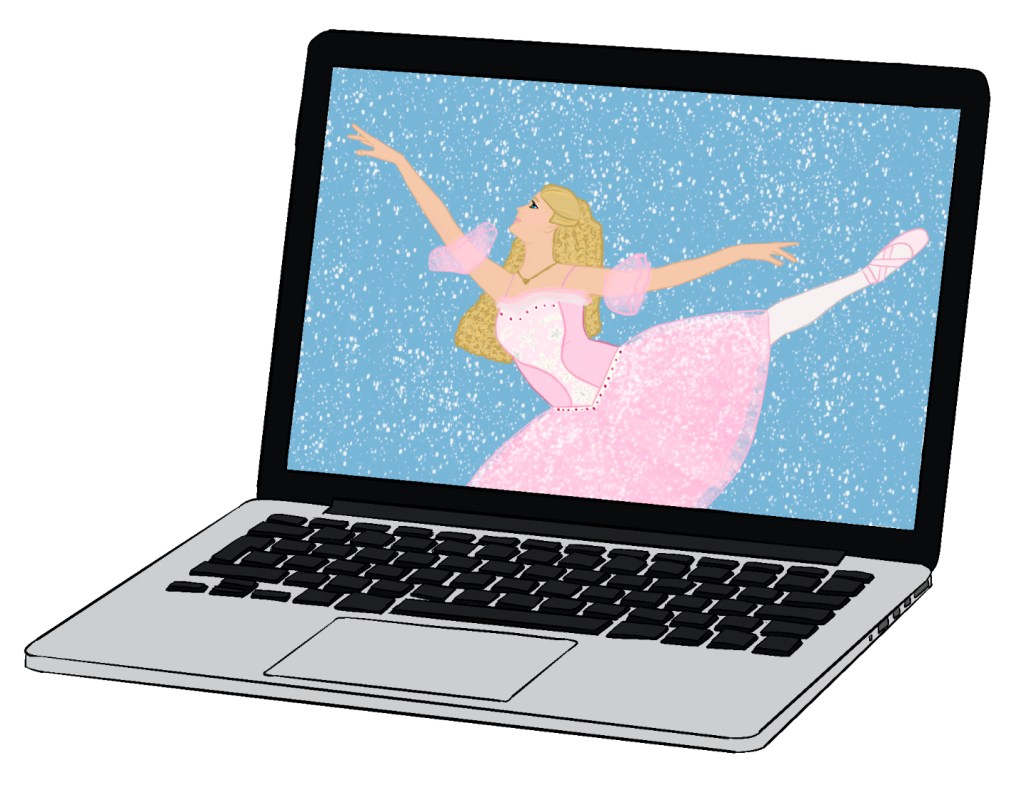
Illustration by Gabrielle Dammkoehler
Imagine, you sit down, intending to watch “Peter Pan” on Disney Plus and experience some childhood nostalgia. Then, before the movie starts you see this content warning:
“This program includes negative depictions and/or mistreatment of people or cultures. These stereotypes were wrong then and are wrong now. Rather than remove this content, we want to acknowledge its harmful impact, learn from it and spark conversation to create a more inclusive future together.” Why is it there?
Media is inherently linked to its cultural context and the artists who create it. These cultures and artists, however, are not always morally upstanding. As we begin to grapple with the stereotypes, prejudices, and harmful rhetoric within specific pieces of entertainment, we enter the conversation about the critical and ethical consumption of media.
Barbie and her films are not free of problematic content. From the colonist undertones in Barbie in the Nutcracker to the antisemitic depictions in Barbie of Swan Lake and the lack of diverse lead characters, some have deemed the franchise wholly unwatchable.
But is it?
Is it possible to ethically consume problematic media?
This question surrounds not only Barbie but also many beloved but flawed films, books, and franchises. Ethical consumption of media continues to be in the spotlight with the release of games like “Hogwarts Legacy” and the ongoing controversy surrounding Kanye West. Can one love “Harry Potter” while knowing that J.K. Rowling is transphobic? Can a kid have a plush Dumbo in light of the presence of the Jim Crow characters?
The list goes on and on and confronting troubling content embedded in media is an ethical quandary that many find themselves grappling with today, especially socially conscious college students.
There are two general ways in which a piece of media becomes problematic.
First, either the creator or a member within a production says or does something problematic. Think J.K. Rowling’s anti-trans tweets or Kevin Spacey’s alleged sexual abuse.
Second, media becomes tainted when the content itself contains problematic and outdated depictions and ideas like the inaccurate, negative portrayals of Native Americans in “Peter Pan” or actors in yellowface in “Breakfast at Tiffany’s”. This is most often seen in older media but can also be present in modern media.
This second category encompasses the problems within the Barbie film franchise. Though not as egregious as other examples of problematic media, the problematic nature of some of the films must be addressed.
Frequently in conversations regarding the consumption of media, people fall into two categories. Either they intend to consume the media regardless or they plan to boycott it altogether. However, there is a third potential method of consuming problematic media. Perhaps the most ethical way to treat problematic media is critical consumption.
In Maura Edmond’s article “Careful consumption and aspirational ethics in the media and cultural industries: Canceling, quitting, screening, optimizing,” she writes about a new type of media consumer.
Edmond writes, “…careful consumers care about the conditions and contexts under which media and culture is made and circulated, including the hierarchies of power and control they help to maintain. We are also very careful about what media and culture we consume and how we rationalize those choices among close-knit and wider communities.”
Production companies have already started to contend with their own histories of problematic media. Both Disney and Warner Bros. have created content warnings for their media with prejudiced content.
The Disney content warning also serves as a call to action. Playing before various movies, it acknowledges the harm caused and asks viewers to have conversations about the content that will lead to a more inclusive future. Disney provides a link to a site where people can learn more about the specific issues present in their movies and see the steps they are taking to better reflect human diversity in their stories.
As Warner Bros. writes in their own content warning, “These depictions were wrong then and are wrong today. While the following does not represent the Warner Bros. view of today’s society, these cartoons are being presented as they were originally created, because to do otherwise would be the same as claiming these prejudices never existed.”
Written by Catherine Slenker and Gabrielle Dammkoehler
Citations
Edmond, M. (2023). Careful consumption and aspirational ethics in the media and cultural
industries: Canceling, quitting, screening, optimizing. Media, Culture & Society, 45(1),
92–107.
Stories matter – the walt disney company. Stories Matter – The Walt Disney Company. (n.d.).
Retrieved March 20, 2023, from https://storiesmatter.thewaltdisneycompany.com
/#:~:text=This%20program%20includes%20negative%20depictions,a%20
more%20inclusive%20future%20together.
Warner Bros. Home Entertainment Warning screens. Company Bumpers Wiki. (n.d.). Retrieved
March 22, 2023, from https://company-bumpers.fandom.com/wiki/Warner_Bros._
Home_Entertainment_Warning_Screens#April_18,_2006%E2%80%93present_(HD_DV
D/BD/4K_UHD_Only)
 Creighton Digital Storytellers